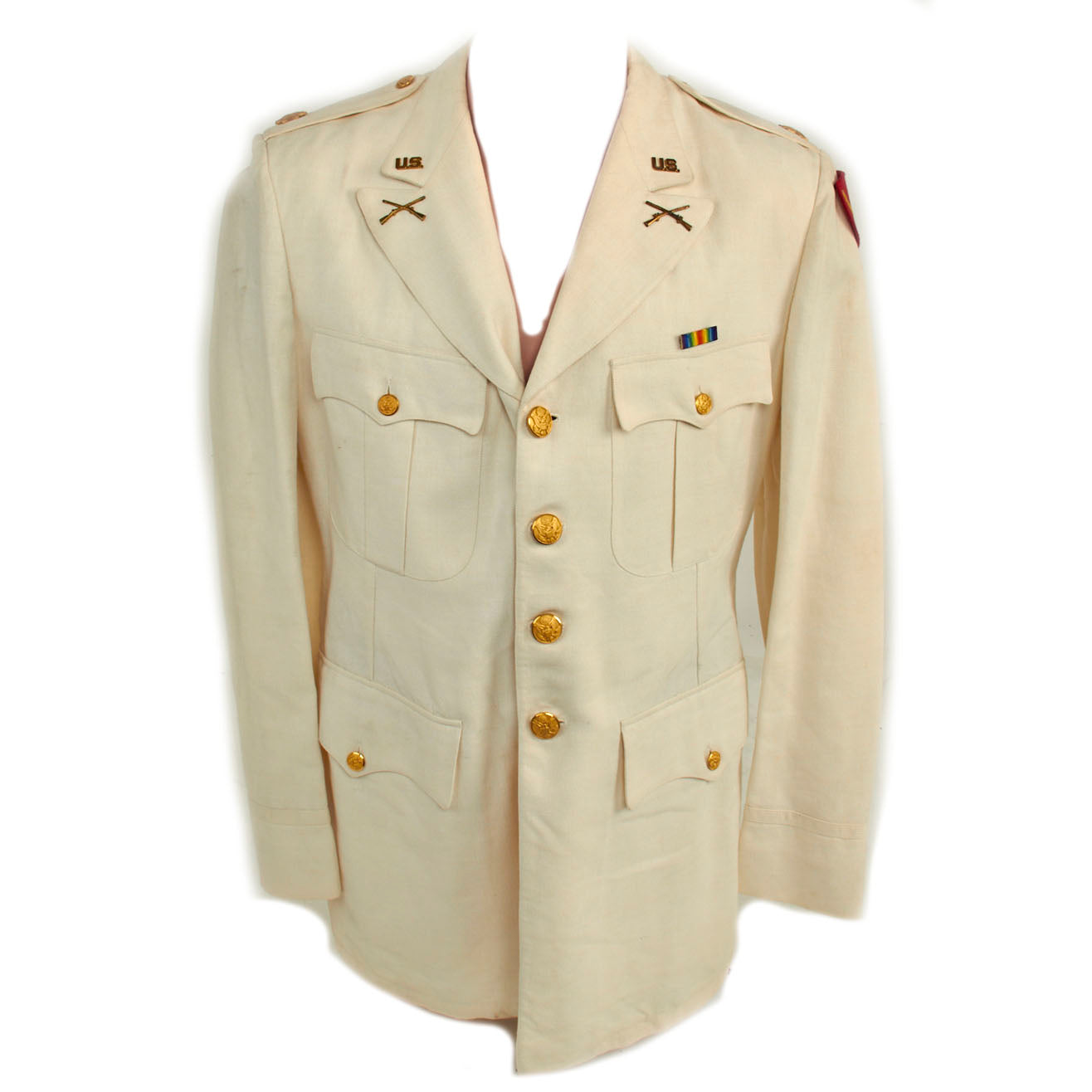
army dress white uniform Original U.S. Early WWII US Army Major's Philippine Division Tropical –  International Military Antiques
SKU: 60105220957
army dress white uniform

army dress white uniform Original U.S. Early WWII US Army Major's Philippine Division Tropical – International Military Antiques

Sale price$23.50 Regular price$26.11
Save 10%
Size: 4

Pay in installments of $6.53 with ShopPay, AfterPay and Klarna

Shipping Estimate
USA
  • USA
  • CAN

Ships within 48 hours · Estimated delivery Jul 4 - Jul 9

Promo Codes Available:

For Your Every Summer RSVP, with Code: SUMMER15

Description

army dress white uniform Original U.S. Early WWII US Army Major's Philippine Division Tropical – International Military AntiquesOriginal Item: Only One Available. Dress whites weren't just for the Navy for much of U. S. military history. Both the Air Force and the Army sported nifty dress whites, as did the Marine Corps. The uniforms weren't just for formal ceremonies, either. They were worn as an everyday uniform for troops in tropical climates, such as, in this case, the Philippines. Air Force Chief of Staff Merrill McPeak did away with the Air Force whites in the early

Original Item: Only One Available. Dress whites weren't just for the Navy for much of U.S. military history. Both the Air Force and the Army sported nifty dress whites, as did the Marine Corps. The uniforms weren't just for formal ceremonies, either. They were worn as an everyday uniform for troops in tropical climates, such as, in this case, the Philippines.

Air Force Chief of Staff Merrill McPeak did away with the Air Force whites in the early 1990s, and the Marine Corps whites were phased out by 2000. The Army held on a little bit longer, doing away with the uniform in 2007.

This wonderful early WWII Dress White jacket belonged to a Major in the US Army’s Philippine Division. This Major, who remains unidentified due to only having a laundry number (8290A), could very well have been a victim of the atrocities committed by the Japanese after the unit’s surrender.

Units of the Philippine Division were on security missions at Manila, Fort McKinley, and Bataan prior to the declaration of war in the Pacific, 8 December 1941. After undergoing 2 days of bombings, the Division moved into the field to cover the withdrawal of troops to Bataan and to resist the enemy inthe Subic Bay area. From 11 to 23 December, positions were organized and strengthened and on 23 December the Division was assigned to the Bataan Defense Forces. While the 31st Infantry moved to the vicinity of Zig-Zag to cover the flanks of troops withdrawing from central and southern Luzon, 30 December, the rest of the Division organized the main and reserve positions on Bataan. The 31st Infantry moved to a defensive position on the west side of the Olongapo Road near Layac Junction, 5 January 1942. This junction was lost on the 6th, but the withdrawal to Bataan had been successfully concluded.

The Division was placed in reserve from 7 to 14 January 1942. This period was largely one of reconnaissance and development by the Japanese in preparation for their attack on the main battle position on the Abucay line. Elements repulsed night attacks near Abucay, 10-12 January,, and other elements of the Division counterattacked on the 16th. Strong offensive and defensive action was not able to prevent enemy penetrations and the Division withdrew to the Reserve Battle Position in the Pilar-Bagac area, 2 January. Until the latter part of March the enemy, made cautious by heavy losses, engaged in patrols and limited local attacks, and after a general retirement, 24 February, did not undertake any serious activity on this front until 28 March. During this period elements of the Division were shifted to assist in the defense of other sectors. The enemy attack on 28 March struck at a division weakened by malnutrition, sickness, and prolonged exposure to combat.

The Division, no longer operating as a coordinated unit, was unable to counterattack against heavy enemy assaults. On 8 April, the 57th Infantry and the 31st Infantry were lost near the Alangan River, and the 45th Infantry surrendered, 10 April 1942. The victory over Japan ended the misery of Japanese prison camps for the survivors of the Philippine Division.

The overall condition of the uniform dress jacket is close to excellent. The white color is still very much the original color and has minimal age toning and virtually no stains present that we can find on the exterior. All buttons are present, each shoulder has a lovely bronze Oak Leaf for the rank of Major, there is a single WWI Victory Medal Ribbon located on the left front, meaning he could have been a veteran of the Great War or this was just an addition to the uniform.

The left shoulder features a lovely button on shoulder sleeve insignia. The insignia consists of a gold caboshed carabao’s head on a scarlet spade-shaped shield. The carabao is suggestive of the Philippines, and the colors red and gold represent the Spanish heritage of the islands.

This is an excellent opportunity to pick up a fantastic and rather rare US Army Tropical Dress Uniform! Comes more than ready for further research and display.

Approximate Measurements:
Collar to shoulder: 10”
Shoulder to sleeve: 26.5”
Shoulder to shoulder: 17”
Chest width: 20.5”
Waist width: 18”
Hip width: 22”
Front length: 34.5"

Shipping Notes
  • Free Standard Shipping on $100+ Orders to the USA.
  • Except Preorder products are shipped in 48 hours.
  • Delivery to the USA:
  1. Standard Shipping : 3-10 business days
  • If time is of the essence, please consider selecting expedited delivery for faster service.
Exchange/Return Notes
  • We offer a 30-day return/exchange service after receiving.
  • Final sale items are not eligible for returns or exchanges.
  • To process your return/exchange, please contact us at [email protected]
  • Please click here for more details>>> Return & Exchange Policy
SKU: 60105220957

Discover Niche Categories That Outsell army dress white uniform

Top-Converting Item to Boost Your Average Order

4.3 ★★★★★
Based on 75 reviews
Sort
Highest Rating
Newest First
Oldest First
Product Reviews
T
Verified Purchase
TracyAZ
Phoenix, US
★★★★★ 3
Not Durable…Splintered….
Had to chuck these. I loved them at first but they are not durable. Scratched themselves up right away and then the mid sized one started to splinter. I didn’t even have it for very long before I had to get rid of them. Long enough to not be able to return. I prefer the bamboo as far as wood goes, but switched to an antibacterial. It’s crazy because I had the same cutting boards for years and in the past month I’ve had to replace them 3 times now. I was so disappointed because there were such amazing reviews. Sadly that was not the case for me. I give it a 3 because they are absolutely beautiful…..you get points for being beautiful I suppose in this world. But not durable. At least not for me.
WAS THIS REVIEW HELPFUL?YesReportShare
Reviewed in the United States on January 22, 2026
E
Verified Purchase
EmmaNuelle
Charlottesville, US
★★★★★ 5
Perfect cutting board set of 3
Very nice cutting boards, and I especially love the peace of mind knowing there is not harsh chemicals used to make these. Thank you!
WAS THIS REVIEW HELPFUL?YesReportShare
Reviewed in the United States on May 27, 2026
A
Verified Purchase
Amanda H. Williams
Massapequa, US
★★★★★ 5
Fascinating exploration of God's Word!
Urban Legends of the New Testament: 40 Common Misperceptions is an impressive work by David A. Croteau that discusses 40 "commonly circulated myths, repeated throughout the culture as common knowledge, but which isn't true." But we're talking about the infallible Word of God, right? That is correct. But according to the author, certain passages of the New Testament have become victims of the notorious Urban Legend phenomena. The titles of each chapter are the actual legends and are presented as if the author really believes what he is writing to be true. The reader will soon find out that is not the case. Croteau goes on to discuss the incorrect interpretation versus an accurate interpretation and then ends the chapter with his opinion of what the text means, followed by a practical application section. The presentation and discussion of each myth is clear, although some are harder to piece through than others. The length of the chapters vary according to the history of the myth and depth of the discussion. Topics vary from the birth, life, and crucifixion of Jesus to Paul's profession, the plan of salvation, hell, divorce, money, pastors and their families, and cults. You can pick up the book and read only the chapters that interest you, although I do encourage you to read the introduction and epilogue. The prologue discusses two types of legends: a mistaken-contains wrong information; misleading-those that need clarification. The cause and solution for urban legends of the New Testament come down to three components: Context, Greek, and Backgrounds. Croteau clearly discusses this at the end of the book and my only criticism is that I would have liked that information in the introduction. I believe it would have aided in my overall structure for comprehension. Overall, the research was fascinating and I learned—a lot. This quote from the final conclusion summarizes the purpose of this book: "In the end our goal should be to interpret Scripture as accurately as possible, to apply that interpretation to our own lives, and to be transformed by God's Word so that our lives may bring glory to the One who rescued us from an eternal destiny in hell." I highly recommend this book to all readers. Don't plan to read it in one sitting. Use it as a study guide and tool to inspire you to dig deeper into God's Word.
WAS THIS REVIEW HELPFUL?YesReportShare
Reviewed in the United States on January 12, 2016
J
Verified Purchase
John Lim
Chelsea, US
★★★★★ 5
Only Orthodoxy Will Lead to Orthopraxy and Orthopathy
Format: Kindle
This book authored by David Croteau is truly an enjoyable yet at the same time a convicting read. Even though it was written about 10 years ago, the principles of interpretation advocated by him to deal with the "mistaken and misleading legends" are timeless. Out of the 40 legends, I have encountered at least half of them in the local church, writings and even seminary especially issues pertaining to salvation, Christian living and women's adornment. The main takeaway is this: Just as there are three things that matter in property: "Location, Location, Location", similarly the three main things that matter in interpretation of the Word is: "Context, Greek, and Background Information", or even simpler: "Context, Context, Context". David Croteau has demonstrated in his 40 legends the utmost importance of context in correctly interpreting a particular passage which was unfortunately taken out of context. The interpretation can further be handled even more accurately by taking into account the Greek language and the socio-historical background behind the text. In fact, I have been focusing on these three elements in my hermeneutical approach whenever I come across passages which I need more understanding. I don't know Greek; but with the many useful online Greek tools nowadays, I can always do a word study which more or less balances my lacking of Greek knowledge. Also, the study of socio-historical background is extremely illuminating if one have access to these resources. Personally, I discover that a proper understanding of background information can eliminate most of the mistaken or misleading interpretation of a text. Lastly, I totally agree with David Croteau's conclusion: "In the end our goal should be to interpret Scripture as accurately as possible, to apply that interpretation to our own lives, and to be transformed by God’s Word so that our lives may bring glory to the One who rescued us from an eternal destiny in hell." His conclusion reminds me of a phrase which I encountered years ago: "Orthodoxy Will Lead to Orthopraxy and Orthopathy." Indeed, only by "accurately handling the word of truth" (2 Tim 2:15) can we realise the necessity of holy living and the proper response that we should have towards our living God.
WAS THIS REVIEW HELPFUL?YesReportShare
Reviewed in the United States on April 6, 2025
J
Verified Purchase
Josh Gerber
Lexington, US
★★★★★ 5
The book is also great in pointing to additional resources for further study
Format: Paperback
Other than the Bible, I hesitate to use the term "must read" for a book. This one is definitely a "should read" for anyone who teaches, preaches, or wants to minister more faithfully. The book is engaging, and offers both a negative (doesn't mean this) and positive (means this) response to common urban legends of the NT. You'll be surprised by some beliefs you had that you didn't even realize were not correct, or should be adjusted. The book is also great in pointing to additional resources for further study. Pastors, seminarians, and lay people will all benefit from this book.
WAS THIS REVIEW HELPFUL?YesReportShare
Reviewed in the United States on July 17, 2015

recommand products