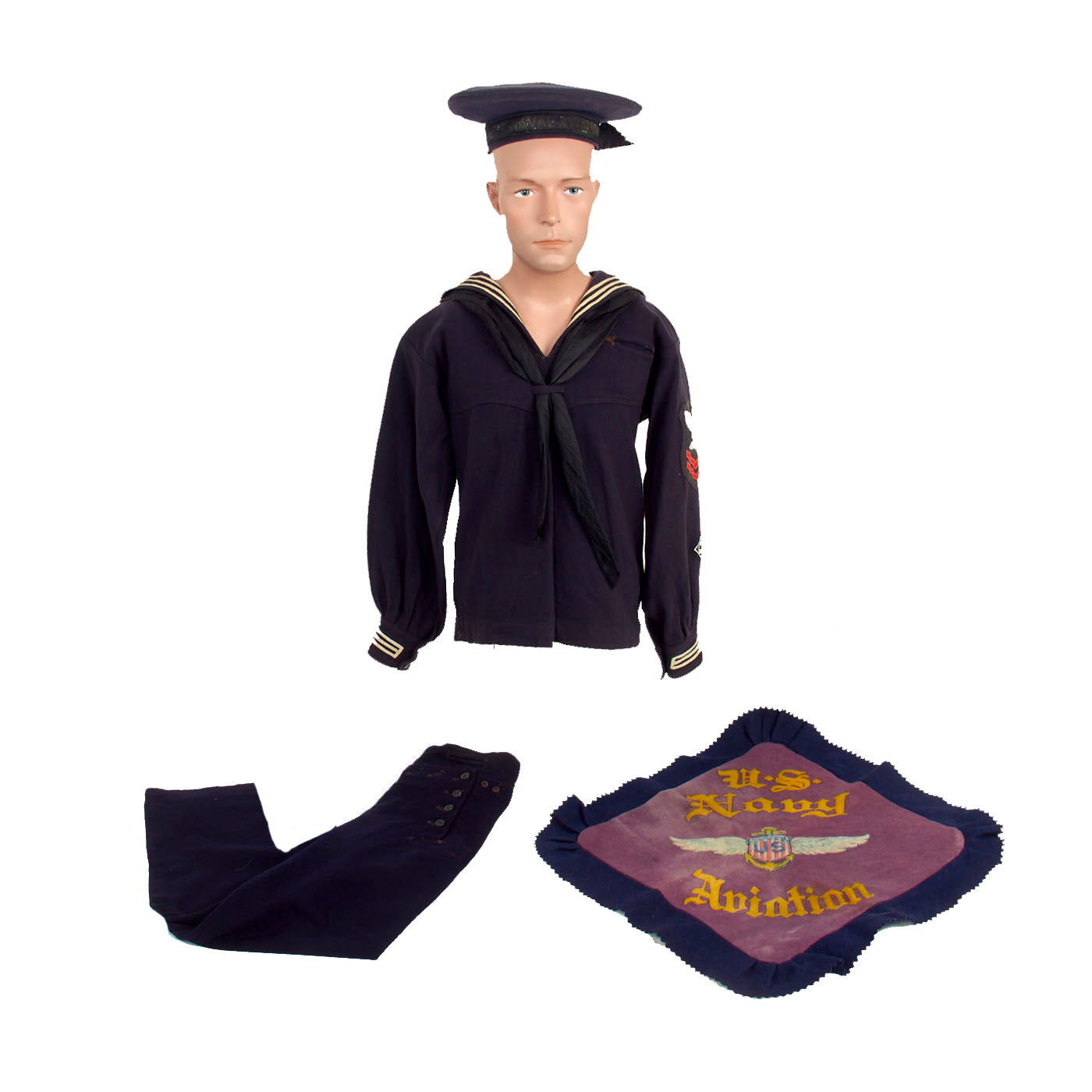
us navy dress blues Original U.S. WWI US Navy Named Aviation Crewman’s’ Dress Blue Uniform Set
SKU: 44326113358
us navy dress blues

us navy dress blues Original U.S. WWI US Navy Named Aviation Crewman’s’ Dress Blue Uniform Set

Sale price$18.79 Regular price$20.88
Save 10%
Size: 4

Pay in installments of $5.22 with ShopPay, AfterPay and Klarna

Shipping Estimate
USA
  • USA
  • CAN

Ships within 48 hours · Estimated delivery Jul 3 - Jul 8

Promo Codes Available:

For Your Every Summer RSVP, with Code: SUMMER15

Description

us navy dress blues Original U.S. WWI US Navy Named Aviation Crewman’s’ Dress Blue Uniform SetOriginal Items: Only One Set Available. The US Navy dress blues have been in service for over 150 years and are still worn today. On a couple of occasions the Navy tried to replace the uniform. First, in the mid 40s, an "Ike" style uniform featuring a short jacket was tried out and was soundly rejected after its trial period. Then, between 1973 and 1980 the uniform was, in fact, briefly replaced with a more contemporary suit and visor cap design only

Original Items: Only One Set Available. The US Navy dress blues have been in service for over 150 years and are still worn today. On a couple of occasions the Navy tried to replace the uniform. First, in the mid-40s, an "Ike" style uniform featuring a short jacket was tried out and was soundly rejected after its trial period. Then, between 1973 and 1980 the uniform was, in fact, briefly replaced with a more contemporary suit and visor cap design only to return to the tried-and-true dress blues. The uniform's main qualities of comfort, practicality, and a distinctive design have endeared it to the sailor. Iconic in appearance, the primary WW2 dress blue outfit consisted of a beret style cap with a ribbon and bow around the band; a "V" neck jumper with a square sailor's collar; a silk neckerchief; and bellbottom trousers with a 13-button broadfall front. Although its design features evolved from needs that had long since passed into history and were archaic even by WW2 standards, the uniform provided the sailor with an instantly recognizable uniform that boosted morale, evoked esprit de corps, and honored the Navy's proud history.

Photos dating back to at least the early 1860s show US sailors wearing a blue wool uniform not too different from the WW2 design. Through much of its early years the uniform was worn at sea, but by WW2 it had become mainly a dress uniform used for more formal occasions such as in formations, ceremonial activities, or for special guard duty. It was also worn on shore leave in appropriate climates. In fact, during WW2 it is most often seen being worn in northern shore and training stations by new recruits. The shift from a practical working uniform to one used for dress occasions was inevitable as military doctrine was evolving during the 1930s and 40s by setting specific roles for uniforms and establishing clear distinctions between work, garrison, and combat attire. And by the end of WW2 the age of multi-use uniforms had passed.

The dress blue jumper and trouser combination was considered a winter uniform to be worn in cool temperatures. It was constructed of high quality 16-ounce Melton wool that had a fine nap and was relatively soft to the touch. There were appropriate accessories to keep sailors warm on colder days. These included an overcoat made of matching heavy-weight Melton, blue wool knit gloves, and a blue wool muffler. The Dress Blue Uniform was included as part of the enlisted man's initial clothing gratuity. In northern training stations it was issued at induction and in warmer areas not until graduation was complete and final assignment received.

The dress blue uniform underwent continuous refinement over the decades of its use as was typically the case with uniforms that existed for any length of time. This process continued during WW2 with some significant changes being made to the jumper and trousers at the end of 1943. At this time it was decided to shorten the length of the jumper by six inches and simplify the waistband area of the trousers. These changes were implemented primarily to realize savings in a wartime economy by reducing the amount of fabric required to make the uniform and to speed up production by simplifying the manufacturing process.

Service Dress Blues for male junior enlisted sailors are based on the classic sailor suit in navy blue, colloquially referred to as "crackerjacks" because of the sailor-suited figure that adorns the packaging of Cracker Jack snacks. It consists of a navy blue wool pullover jumper with an elongated "tar-flap" collar adorned with three rows of white stripes and two white stars, one at each corner of the collar. The jumper's cuffs are similarly adorned with white stripes. A black silk or synthetic fiber neckerchief, rolled diagonally, is worn around the neck, under the collar, with the ends tied in a square knot in the center of the chest. The trousers for the uniform are flared as "bell bottoms". The trousers have traditionally featured a broad-fall opening, though changes to the trousers announced in 2012 have added a zippered fly, rendering the buttons merely decorative.

The jumper features a lovely 2nd Class Aviation Quartermaster shoulder sleeve insignia on the left shoulder. It is in lovely condition with minor moth mips present and no significant damage. The bottom inside waistline has the name R. L. CALDWELL present. Due to how common this name is, it is rather difficult to locate any solid service information, making for a wonderful research opportunity.

The blue cloth cap was remarkable for its longevity having served as an essential part of the enlisted sailor's uniform for over one hundred years. During its considerable time in service, the blue cap sailed on frigates, sloops, paddle wheels, submarines, battleships, and aircraft carriers. It was present for the transition from sails to steam to fuel oil, and even lived to see the advent of nuclear propulsion. But perhaps, most of all, the cap brings back memories of great armadas, the age of Dreadnoughts, and the historic conflicts they partook in.

Recorded in the Navy Uniform Regulations as early as 1833, the blue cap was originally part of an ensemble of clothing prescribed for enlisted seamen to be worn outdoors in both cold and warm weather. Early regulations simply described a "Blue Cloth Cap" until the Civil War period when the wording was slightly changed to "Blue Cloth Cap, without visor".

The circumference of the pre-1933 cap was much larger and required a wire stiffener on the inside to help keep its shape. Just like a lot of other sailors, the stiffener was removed to attribute a saltier appearance. The 1933 cap had a front riser that lifted the crown well above the ribbon. Additionally, the crown of the 1933 cap was attached to the sides using a cord seam, which is not present on this one. Prior to 1941, the vessel's name or any one of a number of different shore station designations could be displayed on the ribbon. In this case it's U.S. NAVAL AVIATION. The cap is in lovely condition and is even beautiful marked on the inside with block letters as:

R. L. CALDWELL
U.S.N.
AVIATION

Accompanying the uniform set is a lovely “sweetheart” wool pillow case. The pillow case dates to late WWI and is in lovely condition with faded colors but still displays wonderfully.
Early aviation items are amongst some of the most difficult items to come across, especially US Navy aviation items. This is a wonderful opportunity to add a researchable uniform to your collection.

Comes more than ready for display.

Approximate Measurements
Collar to shoulder: 10”
Shoulder to sleeve: 19.5”
Shoulder to shoulder: 17”
Chest width: 16.5”
Waist width: 16”
Hip width: 16”
Front length: 21"

PANTS:
WAIST:13"
INSEAM:28"

Upon the United States' entry into World War I, the U.S. Navy had one air station, located at Pensacola, Florida. Available for service were 48 aviators and students, along with 54 aircraft. Prior to the war, the only war experience Naval Aviation had was with photo reconnaissance at Veracruz, Mexico in 1914. In the subsequent rapid build-up, Naval Air Stations were concentrated on the eastern coast, including Anacostia, Washington, D.C.; Bay Shore, Long Island, New York; Cape May, New Jersey; Chatham, Massachusetts; Hampton Roads, Virginia; Key West, Miami, and Pensacola, Florida; and Rockaway Beach, New York.

Exceptions were at North Island, San Diego (used by the U.S. Army for training and schools); Akron, Ohio (for lighter-than-aircraft); and Camp Taliaferro, Fort Worth, Texas (an aerial gunnery school). During the war, naval aircraft flew more than three million nautical miles while also attacking and damaging a dozen German U-Boats. When hostilities ceased, U.S. Naval and Marine Corps Aviation were operational out of 27 bases in Europe, two in Canada, and one in the Canal Zone, one in the Azores, and 12 in the United States. At the time of the Armistice, naval aviation had 6,716 officers and 30,693 men serving. The Marine Corps had 282 officers with 2,180 men. Of these, 18,000 officers and men served abroad. Craft totals: 2,107 aircraft; 15 dirigibles and 215 kite balloons.

Shipping Notes
  • Free Standard Shipping on $100+ Orders to the USA.
  • Except Preorder products are shipped in 48 hours.
  • Delivery to the USA:
  1. Standard Shipping : 3-10 business days
  • If time is of the essence, please consider selecting expedited delivery for faster service.
Exchange/Return Notes
  • We offer a 30-day return/exchange service after receiving.
  • Final sale items are not eligible for returns or exchanges.
  • To process your return/exchange, please contact us at [email protected]
  • Please click here for more details>>> Return & Exchange Policy
SKU: 44326113358

Discover Niche Categories That Outsell us navy dress blues

Top-Converting Item to Boost Your Average Order

4.7 ★★★★★
Based on 1459 reviews
Sort
Highest Rating
Newest First
Oldest First
Product Reviews
M
Verified Purchase
Matthew
Cuba, US
★★★★★ 1
Poor read
Format: Paperback
Not worth the hype. Was poorly written and had to put it down and not finish it.
WAS THIS REVIEW HELPFUL?YesReportShare
Reviewed in the United States on May 20, 2025
T
Verified Purchase
T
Dallas, US
★★★★★ 4
Great story
Format: Paperback
I’m not an avid reader, but this was finished in a few days. Such a good book!
WAS THIS REVIEW HELPFUL?YesReportShare
Reviewed in the United States on June 14, 2025
A
Verified Purchase
AMD
Birmingham, US
★★★★★ 3
Won’t be buying book two.
Format: Paperback
Entertaining enough but poorly written. Lots of typos. Won’t be buying book two.
WAS THIS REVIEW HELPFUL?YesReportShare
Reviewed in the United States on July 8, 2025
D
Verified Purchase
Dr.C.J.Singh.Wallia
Whiting, US
★★★★★ 5
An Excellent Primer on Novel-Writing
Format: Paperback
WIRED FOR STORY By Lisa Cron Reviewed by C J Singh (Berkeley, California) Excellent Primer on Novel-Writing In Berkeley, California, we happily have access to four independent bookstores that display literary novels and creative-writing craft books. Browsing, I picked up two books by Lisa Cron on using "Brain Science" for writing fiction. The jacket quote by Caroline Leavitt rivetted my attention: "I'd never consider writing a novel without Lisa's input, and neither should you." As a longtime fan of Leavitt's novels "Is This Tomorrow," " Pictures of You, " "Girls in Trouble," I looked up Stanford Continuing Education where Leavitt regularly teaches online courses. As a Stanford Alumnus (Psychology PhD), I've taken several on-campus and online workshops on fiction-writing. While still at the bookstore, I promptly signed up for Leavitt's soon-to-begin course that uses two coaching books: Cron's Wired For Story and John Truby's The Anatomy of Story. I'm familiar with Truby's book and its nine excellent exercises. See my detailed review on amazon: https://www.amazon.com/review/R29NU7U6LAHGBV/ Here's my review of Lisa Cron's "Wired For Story" "WIRED FOR STORY' presents a unique, distinguishing feature among fiction-writing primers: throughout its text, the author includes excerpts from the published works of leading contemporary brain-scientists that validate the principles of narrative craft. Cron explains the principles of narrative craft in twelve well-organized chapters that focus on theme, the protagonist's issue, characters' bios, points of view, rising conflicts, subplots, suspense, reveals, and the arc from setup to payoff. At the beginning of each chapter, she presents sentences in italics that illuminate the cognitive-science underpinnings of narrative craft. Examples follow. "Cognitive Secret: When the brain focuses its full attention on something, it filters out all unnecessary information. Story Secret: To hold the brain's attention, everything in a story must be there on a need-to-know basis" (page 23). . "Cognitive Secret: Everything we do is goal directed and our biggest goal is figuring out everyone else's agenda, the better to figure out our own. Story Secret: A protagonist without a clear goal has nothing to figure out and nowhere to go" (p 65) . "Cognitive Secret: It takes long-term, conscious effort to hone a skill before the brain assigns it to the cognitive unconscious. "Story Secret: There's no writing; there's only rewriting" (p 219). Also remarkable are sentences in bold that challenge advice offered in some writing-craft workshops and books. Examples follow. "Myth: Write What You Know. "Reality: Write What You Know EMOTIONALLY" (p 62). . "Myth: Sensory Details Bring a Story to Life." "Reality: Unless They Convey Necessary Information, Sensory Details Clog a Story's Arteries" (p 118). . "Myth: `Show, Don't Tell' Is Literal - Don't Tell Me John Is Sad, Show Him Crying. "Reality: `Show, Don't Tell Is Figurative - Don't Tell Me John Is Sad, Show Me WHY He's Sad" (p 152). Has the author introduced a Myth of her own? I am afraid so. On page 57, "No matter whose point of view you're writing in, you may be in only one head per scene." In my opinion, the Reality is: No matter whose point of view you're writing in, you may be in only one head per PARAGRAPH. This is the new reality -- virtually every fiction-readers' perception has been reshaped by watching films and TV dramas that imply the camera engaged in frequent head-hopping in a scene. At the end of each chapter, Cron presents a concise series of checkpoints to remind the readers while they develop their work-in-progress. Throughout, she includes many examples from literary works and films. Literary works like Gabriel Marquez's "Love in the Time of Cholera," Margaret Mitchell's "Gone with the Wind," and Caroline Leavitt's "Girls in Trouble." Films like "It's a Wonderful Life," "Vertigo," and "American Graffiti." An inspiring citation for writers: " `Recent breakthroughs in neuroscience reveal that our brain is hardwired to respond to story.... It turns that a powerful story can have a hand in rewiring the reader's brain -- helping empathy, for instance - `which is why writers are, and always have been among the most powerful people in the world'. " (On p 239 of Endnotes is the specific citation of three scientists' 2009 article "On Being Moved by Art: How Reading Fiction Transforms the Self" in the Creativity Research Journal vol. 21, no.1 ) WIRED FOR STORY fully earns its title with its numerous citations of recent contributions of neuroscience that validate narrative craft. Examples of cited works included are: V. S. Ramachandran's "The Tell-Tale Brain: A Neuroscientist's Quest for What Makes Us Human"; Michael Gazzaniga's "Human: The Science Behind What Makes Your Brain Unique; and Steven Pinker's "How the Mind Works." These stellar books illuminate the nexus between art and science; their shining light reflects on Lisa Cron's book as a five-star primer for novel-writing.
WAS THIS REVIEW HELPFUL?YesReportShare
Reviewed in the United States on March 7, 2020
M
Verified Purchase
Matt M
Chelsea, US
★★★★★ 5
Will reading Wired for Story really make you smarter?
Format: Paperback
In my 36th year as a would-be and penniless writer, I found myself exiled to a dark rough and tumble city in the Far West, guns blazing as a steely-eyed wordslinger for hire. But then one day I stumbled upon Lisa Cron's book Wired for Story. The book's title had my curiosity. A few sample pages later grabbed my attention and has held it ever since. But the price wasn't right for a poor, humble English teacher living in China upon a Chinese salary. I had bills to pay, a mistress to please, and habits to feed. It seemed to me that Amazon.com was colluding with other dark powers to suck humanity dry; why else would they charge more for a digital book than its paper copy? But then I heard ghostly voices, the cinematic intonations of Morpheus telling me to choose between the red and blue pill; Obiwan Kenobi, "Use the Force"; Nike commercials, "Just Do It!"; and other such shadows flickering upon the wall of my TV room. Even this very particular retail website seemed to whisper across all the vastness of cyberspace, reminding me of my destiny via a personalized showcase of products, that I was not just born to buy... So I added it to my cart. About a download and two chapters later I found that I was still happy after the post-purchase buzz ran its course. This book should be required reading for all writers - and anybody else seeking an inoculation against the raging pandemic of competing narratives spewed out from marketers, pundits, prophets, and others posing as guardians of the truth - most of whom seem to be more enraptured than enlightened. For writers though, Wired for Story is quite different from other "how to" books, as Lisa Cron approaches the craft of storytelling from a neuroscientific point of view. She makes the case that writers aren't just entertainers: they are some of most powerful shakers and shapers of human perception. So if storytellers are like snake oil salesmen, then what is the difference? Both seem to be highly skilled in crafting story, using imagery, and evoking emotions, memories, desires. The difference is all about marketing. Salesmen claim to have knowledge, skills, and expertise, that they, and they alone have whatever it takes to get the facts right and fix things. They market their brands cloaked in story, as if they have a monopoly on truth, or at least the can-do spirit and problem-solving experience needed to improve the economy, save the world, whatever. It doesn't matter that time and time again reality proves them wrong; they will always have another story to spin. The difference between those who would use the power of story to express themselves versus those who would use it for personal gain is, perhaps, a fine red line marking the shadowy borders of between ethics and morality. Storytellers differ because they use words to hook audiences and manipulate a willing reader's central nervous system. They make no claims to knowledge or expertise. Indeed, fiction writers will be first to emphasize their work is fictional, and not based on any real life events or people. Their best writing leaves readers thinking, questioning, minds opening, empathizing, expanding their worldviews, the list goes on almost ad infinitum. Storytellers speak for themselves and let audiences think for themselves; pundits speak for others and tell audiences what to think. What's more, the art and craft of story, as well as the talent and hard time in solitary confinement required for their honing, is estimated to take an average storyteller at least 1,000,000 words or 10,000 hours - not including all the reading, language arts development, and life experience necessary to get to a point one needs to seriously embark on such a ludicrous and un-economical vocation. This means that fiction writers who risk everything for dubious prospects of financial reward must have something else driving them - and a good day job. A presidential candidate though, who has genuinely done the time, and crafts speeches with the skill of a poet or bard, should hypothetically have the critical thinking background, moral authority, and empathy to be a great leader. But in the final analysis, actions contradict words; their ability to spin tales proves the old universal theme that the pen is mightier than the sword. Now when I finish Wired for Story sometime this week, I will be one step further on this endless quest to actually sell stories for a living (i.e. stories fit for the fiction aisle of an actual bookstore, not a review for an online retailer). Until then, I'm probably just a hypocrite acting as if a single book alone makes a smarter man, when in fact I know little of anything (which is why I became a writer in the first place) -- or maintaining such a humble pretense. But I don't know myself well enough to be certain. That kind of exploration would be a whole other story - but it would be unsafe to say that I lived happily ever after reading this book. The End
WAS THIS REVIEW HELPFUL?YesReportShare
Reviewed in the United States on October 11, 2012

recommand products